Racism In Sports: Introduction
Sports are an integral part of society, they generate billions of dollars of revenue, employ millions of people worldwide, and provide entertainment to hundreds of millions of people. It is one of the biggest industries on the planet, like many industries, they are plagued by a number of issues. One of the biggest issues in sports all over the globe is racism. Racism is a problem with society that need to be fixed, but this problem should not be brought into sports, which are meant for many to be an escape from the problems of life. People don't just walk into the stadium or arena and become racist, they are racist before. It is the responsibility of those who have power in sports to eradicate racism as best they can from their respective sport. My capstone will explore racial issues in various sports and offer solutions on how to combat these problems.
Historically, sports and race have always been intertwined. Racism has long been an issue in society, and several times sports has been able to combat racism through various ways. The best way in my opinion is through representation and unity. Two great examples come to find that support this. Jackie Robinson became the first African American baseball player in 1947 when he suited up for the Dodgers. He broke the "color barrier" and endured some of the worst torment from fans any athlete could imagine. However, his organization and his team stuck with him, and did not tolerate the racism.This resulted in inclusion of all races in the MLB, pushing racism further out of the league. To accomplish this the league had to stand together, and show that the racists won't win. Another example of unity and representation comes from the New England Patriots in the early 90's. Even over 50 years after Jackie Robinson broke the color barrier in the MLB, there had still never been an African American General Manager in the NFL. In The Dynasty by Jeff Benedict he details on page 73 when Patriots' owner Robert Kraft made history when he hired Bobby Grier to be his GM. At the time of his hiring, 68% of the players were black, yet he was the only person of color to ever be an executive in the NFL. When Kraft was asking people what they though of Grier, one highly respected NFL executive told him "be careful if you hire black people because they're very hard to fire" (Benedict 2020). This small-minded statement did not deter Kraft, motivated to bring diversity to the NFL he appointed Don Lowery to be in charge of community relations, and Andre Tippett to be another executive. The Patriots possessed the most diverse front office in NFL history.
While these examples show the power of representation and unity, issues still remain to this day. They lay a blueprint on how to combat racism throughout the industry. Throughout the the rest of my capstone project I will identify major issues regarding racism in sports, and provide solutions that may help. The common themes of these solutions will be unity amongst the players, coaches, owners and fans, as well as proper representation at all levels. Equal representation can ensure that every angle and point of view is considered while making a change or discussing an issue. Representation allows you to identify or avoid issues, and unity ensures that change happens.
Sean O'Toole
The Whole is Greater Than the sum of its parts
Sports Media, Racial Stereotypes, and Racism in America's Game
Sean O'Toole
Football is the biggest sport in the country, it exists at every level from elementary school to the professional level. High School Football is a full-blown industry in many parts of the country, and College Football is a billion dollar industry. The NFL is the biggest sports league in America, quite possibly the world. Even in a season with limited attendance and safety issues due to Covid-19, football is being played at all levels, and is still extremely profitable. Sundays that used to belong to God, now belongs to Football for close to half the year. It may seem like football is great, it makes money and entertains people, however there is a glaring issue at all levels of the sport, racism.
One of the big issues in the sport when it comes to racism, is how they handled the protest of some of its star players. When San Francisco 49ers Quarterback Colin Kaepernick protested police brutality by kneeling during the national anthem, there was an outcrying from fans, the league, and members of the media, Kaepernick had little support. The NFL wanted no part of the protest, penalizing teams and players who protested. The Media and its coverage can have a big impact on swaying public opinion, in the case of Kaepernick, most outlets did a disservice to him. The media coverage led to the narrative being that he and his fellow protestors were disrespecting the flag, veterans, and the country, when in reality it was in protest of police brutality.
The disappointing media coverage of this situation is nothing new, many sports networks like ESPN want to remain apolitical, so they do little to defend controversial protests like Kaepernick's was. However, in addition to this there appears to be a bias in how sports analysts and reporters view white and black players. A study done by Eugenio Mercurio and Vincent Filak proves this:
"An examination of 4,745 attributions used to describe Black and White National Football League quarterback prospects over a 10-year period revealed data patterns that emphasized racial stereotypes. Black quarterbacks were primarily described with words and phrases that emphasized their physical gifts and their lack of mental prowess. Conversely, White quarterbacks were described as less physically gifted, but more mentally prepared for the game and less likely to make mental errors" (Filak & Mercurio 2010).
This has a trickle down effect throughout the entire industry. The broadcasters are at the top of their field, their opinions and speech not only effects others in their field, but also the people watching. Some of these viewers are prospective broadcasters, who will either consciously or subconsciously carry these opinions with them into their careers. This is also critical to deal with, because it is a more subtle issue than clear racism. These broadcasters are not saying overtly racist things, but they're stereotyping different races, which can be just as harmful. Categorizing Black Quarterbacks as dumb, and White ones as unathletic creates a glass ceiling for all parties involved.
As of right now, I feel some progress is being made. More diverse broadcasting crews are calling games, and this is helping. However, if people are unable to recognize this stereotyping, it will be hard to curve it and people will continue thinking like this for generations to come. The study references how several African-American QB's have entered the league and performed at elite levels, and that this has helped alleviate some of the stereotyping. The problem still persists though. An example of this can be seen with Daniel Jones, QB of the New York Giants. Jones is white, and is more known for his running ability and athleticism vs his passing ability and decision making. As a result he has been given the nickname of "Vanilla Vick." This nickname references Michael Vick, an African American QB who was most well known for his athletic abilities despite being an elite passer as well.

This is where you can see just not being racist isn't enough, you need to be antiracist to stop things like this. While broadcasters and people who cover the NFL might not be overtly racist, this type of racism is still harmful. I think this compares well with what Kaepernick dealt with. While several journalists did have some racist comments about him and his protest, many either offered apolitical statements or took uncontroversial positions on the matter. Standing on the sideline in this manner it was allows for this stereotyping to be passed down for generations, and for someone like Kaepernick to be blackballed by the NFL.

Racial Bias in English Football
Sean O'Toole
The issues with race are not exclusive to American Football, things can be just as bad overseas in England in their most popular sport. In the Premier League online, referees have had to stop matches to have fans removed from the stadium due to racist chants or actions towards non-european players. In addition to the fans overt racism, there is also information that shows referees make rulings that are impacted by the race of the players they're officiating, similar to how announcers in America handle white vs black players differently. A study called A Statistical Study of Racism in English Football that non-white and non-european players were subject to a racial bias by referees, they conducted this study after other studies had found a referee racial bias in most of the American sports leagues.
On paper the league is 25% minority-based players, they investigated whether these players were discriminated against or racially abused. To find this they used stats like appearances, fouls called, yellow cards, red cards, and they also looked at where the referees were from that made these decisions. The study found that their hypothesis was true, and there was possibly racial bias in the league. They found that while though there was no pay discrimination, the stats supported that non-white and non-European players were penalized more, no matter where the referee was from:
" found that non-White players in the EPL were 15% more likely to receive a booking than a White player, after controlling for player, team, referee and match characteristics. Testing implicit discrimination, taking data from the EPL, the study analyzed over one million in-match events looking at British referee reactions to players (with details taken of player actions), and showed that White referees award significantly more yellow cards against non-White players" (Chu et. al. 2014).
The study continued by saying these decisions were typically quick judgement calls in tense situations. This supports that there may be racial bias at play, that in bang-bang plays the benefit of the doubt is given to white players, whereas other players don't get that same benefit.
This study actually found different results than were found in the American leagues. While in both leagues it was quite clear there is racial bias, there was one key difference. It professional leagues in America, the race of the official or referee had a bias with the opposite race, and favored players of a similar races.
In addition to racial bias by referees, there is certainly a racial bias by the club management as well. When it comes to negotiating a transfer fee, clubs are willing to pay more for english players. This is partially due towards a rule where clubs benefit from having "home-grown" players on their squads. However, this is not the sole reason. There is an unwarranted "hype" around English players vs other races. A talented english player is going to cost significantly more than say a Russian player even if their talent in equivalent. This is not a wild theory, there is even a nickname it has been given by pundits and fans, they call it the "English Tax."


The picture above shows Jadon Sancho, a great example of the inflated pricing of English Players. According to transfermarkt.us, he has an estimated value of $110 million. While there is no denying Sancho's talent, there is no reason he should be worth this amount. A comparable player, Kai Havertz (right), came from the same league, both play a similar role with similar production and are the same age. The only difference is Kai Havertz is German, so he is valued significantly less, at $88 million. The benefit of having a homegrown talent is not worth over $20 million, the explanation is that he is English, and any club that wants him will surely be paying "The English Tax."
There are certainly many types racism in the world, I believe in football there are two ones that stand out, I classify these as overt racism, and subtle racism. These are several examples of how racism can sometimes be difficult to identify, but it is there. My next blog post will cover the more blunt racism that is easily visible, and too common in the Premier League.
Social Media, Fans, and Racism in The Premier League and English Football
Sean O'Toole
Footballers, Soccer Players, whatever term you prefer, endure more racism from fans during games than any other sport in my opinion. Where players may take an even amount of racism on social media, no other league can match the racial abuse players take in soccer, I think this is due to a plethora of factors. Some of the factors I believe stem from the large diversity of players in the sport, with non-diverse fans. I also believe a factor is the proximity there is to the players, with a lack of barriers separating the players from hearing what fans have to say. In European soccer, fanbases are more intense than we're used to in many American sports, it as not as much of a family-friendly atmosphere as the NBA or MLB would be, it can be a frenzy. This abuse continues outside of the stadium on social media. The league can no longer hide this and must address it. They have begun to make an effort to fix this, but is it working? Are the powers at be of English Football doing enough?

The image above shows Pierre-Emerick Aubameyang after a Tottenham fan threw a banana at the Gabonese Striker during a match. This is not something uncommon for African and South American players to endure. Other players like Dani Alves, a fullback for brazil have had had bananas thrown at them as well. Many others, like Neymar, Raheem Sterling, Callum Hudson-Odoi and Antonio Rudiger have been called monkeys by fans and even other players. There is also Islamaphobic insults that take place too, The Guardian discusses where two times that Egyptian Mohamed Salah faced abuse. Author Jacob Steinberg said, "In February a West Ham fan allegedly shouted Islamaphobic abuse at Mohamed Salah at the London Stadium, and on Thursday the Liverpool striker was the target of chants by Chelsea supporters describing him as a “bomber”. The abuse is widespread, and goes after every race and every religion without fail.
Racism has been going on in stadiums for decades, but Social Media has opened up a whole new can of worms. The internet brings out more racists, they can hide behind a screen, not worrying about what others may think. The anonymity makes it easier for them to be racist, which tells me that they know what they're doing is wrong. In the study Tackling Social Media Abuse? Critically Assessing English Football’s Response to Online Racism, it found that In the 2014-15 season, 135,000 racist social media posts were made directed at either a team or player, with one player getting over 8,000 by himself. This player is Mario Balotelli, who to this day has continued to be racially abused to the point where he is now out of football despite his ability.
All of the clubs as well as 3 other organizations are ultimately responsible for dealing with this, the FA, the PFA, and Kick it Out. However, they were not able to work in unison, hence they were not very effective in terms of tackling these issues.
"The advent of social media has only added to the complexity of attempting to tackle racism and the evidence presented in this article strongly challenges the assumption by antiracist organizations and the football authorities that racism is being eradicated from football. Technological advances in communication since the beginning of the 21st century have enabled racist and Islamophobic views to operate covertly across message boards and other platforms such as Twitter, rather than overtly inside football stadia" (Cleland 2013).
This evolution has made it difficult for the Clubs, the FA, the PFA, and Kick it Out to fight the war on racism. The internet and social media had too meteoric of a rise for them to even possibly keep up. However this is not an excuse, they need to continue to work towards eradicating racism from the sport. While the league has been strict, and quick to act when removing and banning fans and punishing players for racist abuse, it is tougher to track who is saying what on social media. I think the powers at be care, but I don't think they care enough to allocate the resources to combatting it. They have done great with their campaigns against racism, including Kick it Out, and No Room for Racism, but at times these seem more like PR campaigns vs. genuine attempts to curb the racism.
The real way to curb this is through society. "People don't walk into a football stadium and become racist" (Steinberg 2019). This is reflective of the climate globally, in Europe, and in England. English fans like to think that they're not as bad as Italian Fans, or Eastern European fans, but they are. In an international game vs Montenegro, the black players for England faced abuse in the way of monkey chants. English fans were livid their players faced such abuse, an appropriate reaction. However, the manager Gareth Southgate held them accountable when asked about it, "we have the same issue in our country."
High profile members of English football like Gareth Southgate, Marcus Rashford and Harry Kane are all people who need to keep speaking out about these issues. If they can be the spark for society to begin to change, maybe on day racism can be kicked out of the sport. Until the societal change, any attempt by a governing body in the sport will face an uphill battle, an impossible one to win. A perfect example of how to combat racism in soccer happened just this past week. Paris St. Germain were playing Basaksehir on December 8th in the Champions League, the highest level of competition in European Soccer. Early on in the match the referee signaled to another to issue a warning to one member of Basaksehir's coaching staff. The coach that the referee sought to discipline was Pierre Webo, from Cameroon. This would not have been an issue if the referee had referred to him by his name, instead he called him "that black guy." Senegalese Striker Demba immediately charged the ref in defense of his coach, calling out the referee for his inappropriate description and racist language. The players then united, and walked off the field, refusing to play out the remainder of the match. It didn't matter how important the game was, it didn't matter that they were opponents, they teamed up to fight racism. The match later resumed the following day, without the official who made the racist remarks. This united response by the players worked, it brought global attention to the issue, put pressure on the governing bodies of the sport to do something about the racial issues in the sport and removed a bad apple from the sport.

Players Take the Blame
Sean O'Toole
Like everything on TV, ratings in sports have been heavily effected by the adoption of many streaming platforms, and illegal piracy of live events. With ratings dropping, a lot of the blame has been pushed towards the players. The players have become scapegoats for the ratings decrease, with critics pointing towards their political stances and views. Sometimes this blame is blatant, other times it is very subtle, it really depends on the source. This relationship between the players and fans usually have racial undertones, where white analysts and political pundits point the blame at a person of color standing up for what they believe in. The role of journalism is incredibly important when it comes to how the public feels about the issue. The goal should be to get the facts out and get them out in a timely manner and the public can make their own decision. However, all too often the information is presented to manipulate how a person feels about the issue.
In 2018, one of the biggest stars in the world, Lebron James did and interview where he answered several questions about politics and how he felt about President Trump. Lebron answered respectfully but indicated that he thought the president did not understand the people. He shared his opinions in an honest, humble way, and Laura Ingraham took offense to him having an opinion. Ingraham, a host for Fox News, said on her show that Lebron should "shut up and dribble", and continued to insult his intelligence, and say his words were "ungrammatical" and "barely intelligible". Somehow Ingraham feels that because Lebron is a professional athlete who makes a lot of money, his views don't deserve to be heard. Somehow he is not worthy of having an opinion despite his incredible positive impact he has made in his community. Don't try to understand he logic, it isn't there.
Ingraham is not consistent with her criticism as she claimed. Earlier this year Saints' QB Drew Brees spoke about anthem protests. Nancy Armour described what happened for USA Today. Brees was asked about the kneeling and other peaceful protests and how he felt about it, Brees said;
“I will never agree with anybody disrespecting the flag of the United States of America or our country,” Brees said during an interview with Daniel Roberts of YahooFinance that was posted Wednesday. “Let me just tell you what I see or what I feel when the national anthem is played and when I look at the flag of the United States. I envision my two grandfathers, who fought for this country during World War II, one in the Army and one in the Marine Corps, both risking their lives to protect our country and to try to make our country and this world a better place" ( Armour 2020).
The same people who criticized Lebron two years prior praised Brees, or remained silent. Brees was dead wrong though, he was ignorant and chose to believe what conservative media outlets told him instead of listening to his teammates and adversaries around the league. The anthem protest was never about the flags, or the troops, or any disrespect towards anyone. Kaepernick was careful when figuring out how he would protest police brutality. To figure this out, he spoke with Nate Boyer, a former Green Beret. He and Kaepernick had a discussion and they eventually reached a conclusion that kneeling was appropriate. Boyer suggested it saying that they often knelt in honor of fallen comrades. When mainstream media ignored the real reason for the protest, Brees followed suit. Brees was wrong, he was ignorant, but he learned his errors. Teammates immediately responded, they had emotional conversations with Brees, and he understood the error of his ways, that the kneeling was not disrespecting anyone, rather calling attention to police brutality. This is why being unified is important. Despite widespread representation around the league, they message wasn't united amongst the players, as a result one of the marquee names in the league completely missed the point of the protest.
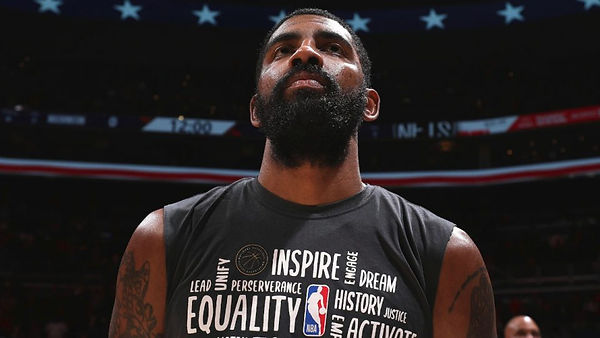
This past year, sports shutdown for months while they figured out a plan to resume safely during a global pandemic. During this shutdown, George Floyd was murdered by a policeman, protests and political change ensued. Nationwide protests sparked changed and as momentum was still growing, the NBA announced it would return in a "bubble" to finish their season out at Disney World. The response was pretty positive, people were excited to have sports back. However Vice President of the NBA Players Association and Point Guard of the Brooklyn Nets Kyrie Irving raised posed a question: Would it be harmful for the NBA to distract people from the protests and black lives matter movement that was beginning to get politicians to enact real change in the country? Countless people hurled insults at Kyrie, calling him all sorts of racial slurs, mocking him, disregarding his intelligence. As expected, Fox News did not hold back when criticizing Irving, bringing up his past to try and discredit him. When Fox News went after Lebron, people stuck up for Lebron, and Ingraham had to deal with her comments. However when people went after Irving, nobody had his back. ESPN's top basketball insider Adrian Wojnarowski essentially wrote a hit piece on Irving following his comments, which only fueled the flames that were engulfing Irving.
Ultimately, the NBA decided to go through with their plans to finish the season in a covid-free bubble at Disney; and Irving is still dealing with the backlash from his comments. Throughout the offseason and months following the season restart, Irving was criticized several times by people around the NBA. In response to this Kyrie released a statement last week saying that he would not be participating in media sessions or fulfilling. The media turned on him quickly. The blue check marks on twitter ganged up on him, he took worse torment that before. But it only proved him right, why should he participate with the media when many members criticized him, and their colleagues stood back and watched.
Irving was right. The NBA going back did distract people from the political revolution that had begun to happen around the country. While in the bubble, Jacob Blake was tragically shot and killed by police. In the following days protests would occur in Wisconsin and a teenage vigilante white supremacist murdered two protestors with a rifle. The Milwaukee Bucks decided to not take the floor for their next game. This had a snowball effect and the NBA had to postpone all games while they figured out what to do next. Ultimately it came down to a player vote. This is where the NBA failed. The majority of players thought it would be best to cancel and go home, where they can help their community. However, some of the players with the biggest names in the league would not agree. Ultimately, the season resumed with some guarantees that NBA owners would do more to help with police reform and voter registration across the nation. In this case, there was proper representation, so some good did happen. However, they fact that the players could not unite, resulted in less impactful change.
This protest provided good ammunition for some media outlets. The NBA had a ratings decline during their restart. This could be mostly attributed to the games being played in the middle of summer, at odd hours, and overlapping with multiple sports. These factors along with piracy were the biggest reason for rating drops. This was not what most media outlets and critics said though, instead these people blamed it on the players protest, and the NBA's decision to support Black Lives Matter. ESPN reported the ratings decline without mentioning anything about BLM or the players, but the image they used showed the players peacefully protesting before a game, subtly indicating "the real reason."
Without the proper support, it is tough for athletes to enact change. Everyone should be entitled to an opinion, just because they are a superstar athlete doesn't meant they shouldn't be able to spread their message. Many of these athletes come from terrible situation, and want to give back, and have experiences many don't have. Most of these athletes are more in touch with the common man and what their needs are than career politicians are. Players have the ability to enact change, and the means to do so. When there is proper representation, and a unified belief, amazing things can be accomplished. Members of the media should not be shooting down or criticizing their opinions in this manner. They can disagree, but do so in a civil way, don't write a hit piece, and report the facts and voice your own ideas.

Conclusion
Sean O'Toole
Sports are polarizing. The passion and intensity spreads from the court, to the community, to the nation, to the world. While sports can be an escape, they can also be a platform. Often time sports can reflect society and they share many similarities. There are complex structures in place both good and bad, there is big issues, and there are small issues. The largest issue both of these share, is racism. It is easy to see blatant racism, but it comes in many nuanced forms. As seen in the previous blog posts it can be as obvious as a fan throwing a banana towards a player, or as subtle as language used by a broadcaster. In both cases it has damaging effects, it is important to rid the world of both types. The way to do this is by proper inclusion and representation from people of every point of view, and uniting to fight for a common cause. You can't fight the problem if you keep fighting amongst yourselves.
Not being racist is not enough. People need to be anti-racist, and fight racism when they see it, not just stand by. This has what has been most effective in sports. Calling out racists, getting them out of the game. Educating others on how to fight this so it does not continue to spread. It is impossible to identify many of these nuances without being properly educated on what's happening. One announcer using a racial stereotype may seem harmless in the moment, until you realize his true impact. The expert says one thing, the fans spread it, future announces bring the same stereotype into the booth with them and the cycle continues.
When people at all levels of sport unite strides can be made. Everyone at all levels need to be held accountable. The best way to do this is through representation and unity. If only a few people are calling out someone for their behavior, whats going to happen? When the captain of the English national team calls you out, and the manager, and the co-captain, things will start to get done. Strength in numbers. When Laura Ingraham told Lebron to "shut up and dribble" there should have been much more support for Lebron than there was. Lebron is possibly one of the top 5 most recognizable people in the world, I'm not sure where Ingraham would be on that list, but I would venture a guess it would be in the thousands. The fact that more people did not stand up highlights some of the issues I mention, where standing by isn't enough to enact change.
I believe that journalism plays a key role in this as well. The most important factors in reporting are timeliness and truthfulness. To find the best example of this you need to look beyond sports. Following 9/11, the Bush Administration was able to control the narrative. They said that this was an attack on our freedom, our way of life, and that we needed to retaliate and invade Iraq. Journalism failed here. They failed to mention in a timely manner a number of reasons why the attacks occurred. They failed to mention it was not Iraqi's who committed the attack, and they failed to mention the US interfering and militarizing the middle east as reasons. As a result, the Bush administration controlled the narrative, and we went to war.
If all of these factors can work together, they can have a huge impact on improving our issues with racism in sports and around the world. With proper representation, unifying under a single message, and good journalism, racism can slowly be eradicated from the sports many people know and love. Sports are not responsible for eradicating racism around the world, but they are responsible for eradicating it in their respective sport. They can then serve as an influence and example to the rest of the world, showing them what is possible if they follow their lead.
References
The Impact of Race Relations on NFL Attendance: An Econometric Analysis
Racism, Football Fans, and Online Message Boards: How Social Media Has Added a New Dimension to Racist Discourse in English Football
A Statistical Study of Racism in English Football
https://gold.worcester.edu:3475/docview/1550070934?pq-origsite=summon
Racism and Stereotyping on Campus: Experiences of African American Male Student-Athletes
https://gold.worcester.edu:3475/docview/1558357460?pq-origsite=summon
Tackling Social Media Abuse? Critically Assessing English Football’s Response to Online Racism
Roughing the Passer: The Framing of Black and White Quarterbacks Prior to the NFL Draft
Sullivan, E. (2018, February 19). Laura Ingraham Told LeBron James To Shut Up And Dribble; He Went To The Hoop. Retrieved from https://www.npr.org/sections/thetwo-way/2018/02/19/587097707/laura-ingraham-told-lebron-james-to-shutup-and-dribble-he-went-to-the-hoop
transfermarkt.us
Armour, N. (2020, June 04). Opinion: As protests rage over racial inequality, Drew Brees' tone-deaf comments show Saints QB is willfully ignorant. Retrieved from https://www.usatoday.com/story/sports/columnist/nancy-armour/2020/06/03/drew-brees-saints-willfully-ignorant-flag-national-anthem-george-floyd/3137613001/